
Q1 2026 Strategic Intelligence Report: Why “Marketing as Therapy” is the New Competitive Mandate

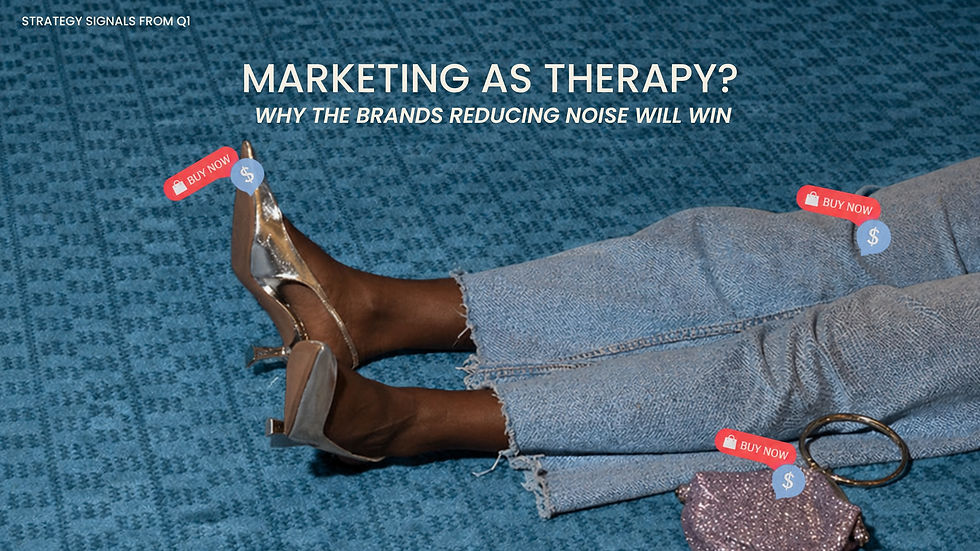
The Q1 2026 signals are officially in. After four months of navigating AI-saturated feeds and a significant shift in consumer psychology, the data from Deloitte, Euromonitor, and Marketing Week points to a singular, undeniable conclusion: The "Attention Economy" is being replaced by the "Regulation Economy."
In 2026, storytelling isn’t about persuasion anymore. It’s about nervous system regulation.
At Social Disruption, we’ve analysed the trajectory of the first quarter to help brands navigate the "Trust Cliff." Consumers are no longer just overwhelmed by choice; they are overwhelmed by digital noise. Q1 was the tipping point. Moving into Q2 and beyond, consumer behaviour is becoming hyper-selective. The brands that win the rest of the year won't be the ones doing "more"—they'll be the ones building better systems that let people choose them without the headache.
1. The Rise of the "Brand Whisper”: Sonic Identity in an Audio-First Era

Every brand has a visual identity. In 2026, very few have considered sonic identity. By March 2026, "Sound-On" social usage peaked, driven by a collective desire to reduce screen time while maintaining digital connection.
As audio-first consumption through podcasts and "slow audio" reels becomes the primary driver of brand intimacy, the visual "shout" is losing its ROI. Consumers are actively filtering, skipping, and muting aggressive visual interruptions.
The Social Disruption Factor:
Brands are moving away from shouting via high-saturation visuals and toward "whispering" via sonic identities. 2026 is the year of the audio anchor, using sound to lower the collective heart rate and create a subconscious trust signal.
2. Community as Comfort: Navigating the “Quiet Web”

Digital fatigue has led to the withdrawal of high traffic public forums. We are witnessing a mass migration toward smaller, intentional spaces, a phenomenon we call the Quiet Web.
Private messaging groups, niche digital harbours, and curated IRL moments are replacing mass-market broadcasting. Brands are no longer building "audiences"; they are hosting ecosystems.
The Social Disruption Factor:
In 2026, reach is a vanity metric; "safe space" status is the gold standard. To build a resilient community in Q2, you must create spaces people want to return to for comfort and clarity, not just scroll past for entertainment.
3. The 2026 Value Shift: From Price to Meaning

According to Euromonitor, 58% of consumers reported "extreme" daily stress in 2026. This has fundamentally changed the value equation. While economic pressure is real, consumer response is more nuanced than a simple price cut.
Consumers are trading down on everyday essentials to "ring-fence" their budget for what feels truly worth it: products that offer emotional reassurance, escape, or identity.
The Consumer Sentiment Buckets:
Utility: Worth the saving (frictionless, low cost essentials).
Identity: Worth the meaning (Experiential, reassuring, premium).
The Social Disruption Factor:
Positioning clarity beats price slashing. If you are a premium brand, you must justify the spend through emotional regulation. Anything undefined in the "middle" is currently being deleted from the consumer’s budget.
4. Why Experience is Outperforming Messaging

Retail is no longer transactional; it is a media channel. In Q1 2026, physical environments became the most powerful storytelling tool in a brand’s arsenal.
Jacquemus: Turning physical pop-ups into cultural "you had to be there" moments.
Alo Yoga: Building wellness ecosystems that integrate into daily lifestyle rituals.
Nike: Leveraging run clubs as a retention engine rather than a marketing campaign.
The Social Disruption Factor:
The consumer expectation has shifted from "Buy from us" to "Belong with us." If people don't feel a shift in their internal state when they enter your brand’s world, you are simply a SKU on a shelf.
5. Unfiltered is Strategically Human: The AI Backlash

Overly polished, AI-generated campaigns have hit a wall of "uncanny valley" fatigue. While AI has scaled content volume, it has simultaneously created a "trust deficit."
What is cutting through in 2026 is the phenomenon called “The Human Residual” - the unpolished, unedited, and the considered. Brands like Rhode Skin and Glossier are winning by leaning into "lofii" authority. Think iPhone shot content and "the process" as the narrative.
The Social Disruption Factor:
AI has raised the bar for human thinking. When the world is flooded with generated perfection, human imperfection becomes your strongest trust signal. In 2026, intimacy is officially outperforming production value.
The Q2 Forecast: The Strongest Signal Wins
The brands that win the rest of 2026 won’t be the ones doing the most. They’ll be the ones that make people feel less overwhelmed, more certain, and more at ease.
As we move into the middle of the year, our strategic mandate at Social Disruption remains consistent: Marketing is no longer about persuasion. It’s about regulation.
In a culture defined by noise, being the strongest signal is no longer just good strategy, it’s the only way to stay visible.
Subscribe to Disruptor’s Digest
Get the full strategic extractions and Q1 data deep-dives delivered to your inbox every month. Join the community of leaders navigating the future of Social Disruption.

Comments